Fulfilment by Amazon (FBA) is one of the most powerful tools available to online sellers. Amazon stores your stock, picks and packs orders, delivers them quickly and handles customer service and returns. In exchange, it charges fees, and lots of them.
The problem is not that FBA is expensive. For many sellers, it offers excellent value. The real challenge comes from Amazon’s complex fee structure. Amazon charges dozens of different fees, deducts them from settlements at different times, and often combines them into a single payout. As a result, many sellers struggle to understand their true FBA cost per unit. They also find it difficult to identify which products actually generate a profit after accounting for every fee.
On top of that, FBA changes how you manage inventory. Amazon stores your stock in its warehouses and transfers products between fulfilment centres. During this process, Amazon may lose or damage items. Customers may also return products, while Amazon may remove or destroy certain units. In some cases, Amazon reimburses sellers for these losses. If you fail to track these inventory movements in your accounting records, you risk reporting incorrect inventory values and cost of sales.
This guide explains the main FBA fee types, how to record them, which costs belong in your inventory value, how to handle reimbursements, and how to work out your true profit per unit.
What is the quick answer?
FBA costs include fulfilment fees per unit, monthly storage fees, aged inventory surcharges, inbound and placement fees, removal and disposal fees, and returns processing. Record each in its own account, not netted off sales. Track FBA stock as your inventory, record reimbursements for lost or damaged units, and calculate profit per unit after every fee to see which products truly make money.
Key takeaways
- FBA fees should be recorded by type, so you can see what fulfilment, storage and inbound actually cost.
- Stock in Amazon’s warehouses is still your inventory and belongs on your balance sheet.
- Some inbound costs may form part of your inventory cost, rather than an immediate expense. Agree the treatment with your accountant.
- Reimbursements for lost or damaged stock are income or inventory adjustments, and are often missed.
- Your true margin is only visible when you calculate profit per unit after all FBA fees.
What are the main Amazon FBA fees?
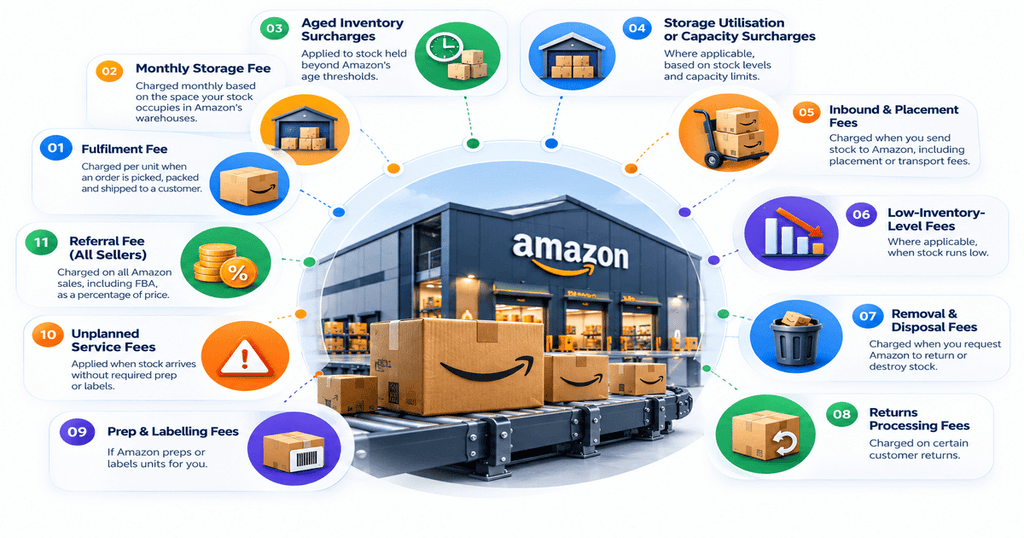
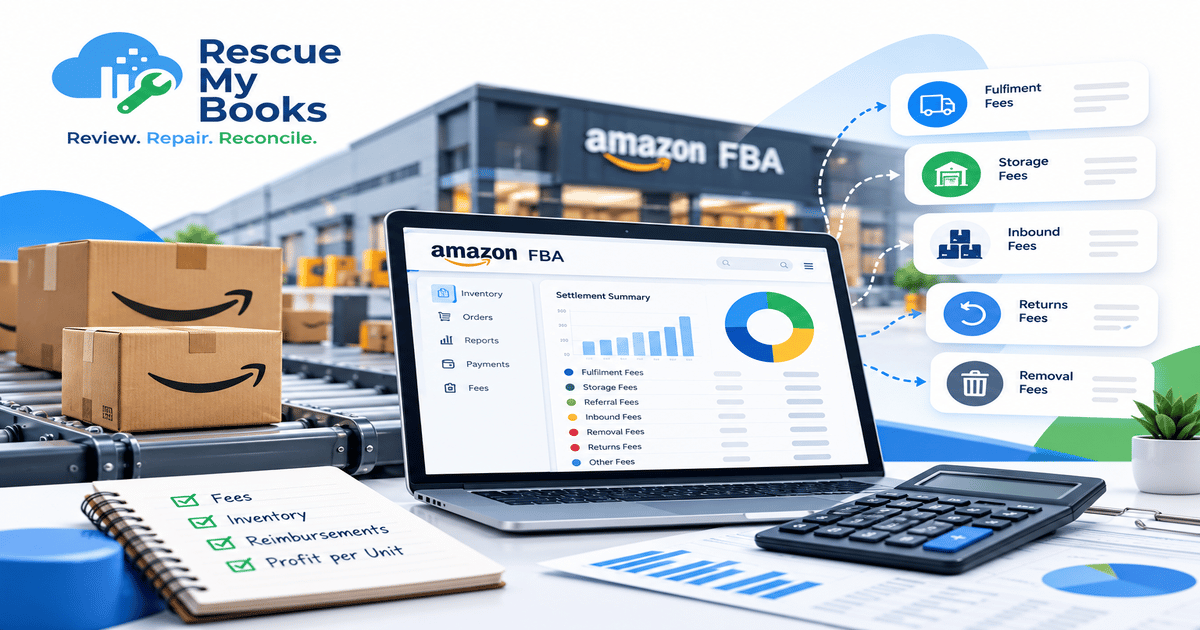
The main FBA fees include fulfilment fees for each unit you sell, monthly inventory storage fees, and aged inventory surcharges for products that remain in Amazon’s warehouses too long. Amazon also charges inbound and placement fees when you send stock to its fulfilment centres. Other costs include removal fees, disposal fees, and returns processing fees. In addition, Amazon charges referral fees on all sales, whether you use FBA or fulfil orders yourself. Fee names and rates vary depending on the Amazon marketplace.
| FBA fee type | When it is charged | Suggested account |
|---|---|---|
| Fulfilment fee | Each unit shipped to a customer | FBA fulfilment costs (cost of sales) |
| Monthly storage fee | Monthly, based on space your stock occupies | FBA storage costs |
| Aged inventory surcharge | Stock held beyond Amazon’s age thresholds | FBA storage costs (or separate line) |
| Storage utilisation or capacity surcharges | Where applicable, based on stock levels | FBA storage costs |
| Inbound placement or transport fees | When you send stock to Amazon | Inventory cost or inbound costs (agree treatment) |
| Low-inventory-level fees | Where applicable, when stock runs low | FBA fulfilment costs |
| Removal and disposal fees | When you ask Amazon to return or destroy stock | Removal costs; write off destroyed stock separately |
| Returns processing fee | On certain customer returns | Returns costs |
| Prep and labelling fees | If Amazon preps or labels units for you | Inventory cost or fulfilment costs |
| Unplanned service fees | When stock arrives without required prep or labels | FBA fulfilment costs |
| Referral fee (all sellers) | Each sale, as a percentage of price | Amazon selling fees |
Why recording fees by type matters
When you combine all Amazon fees into one expense category or deduct them directly from sales, you lose visibility into your costs. This makes it difficult to answer important questions. Are your storage costs increasing? Do high fulfilment fees reduce the profit margin on bulky products? Does keeping aged inventory cost more than the stock itself is worth?
Separate accounts, or a single fees account with tracking categories, turn your profit and loss report into a management tool. Most connector apps, including A2X and Link My Books, can map each Amazon fee type to its own account.
Where FBA fees appear
Most FBA fees are deducted from your settlements and appear as separate lines in the settlement report. Some, such as storage, are charged monthly and may land in a different settlement from the sales they relate to. Amazon also issues fee invoices, which are useful for checking totals and, in some countries, for recovering VAT on Amazon’s fees.
How should FBA storage and inbound costs be recorded?
Record monthly storage fees and aged inventory surcharges as operating costs in the month they are charged. Inbound costs, such as freight to Amazon, placement fees and prep, may qualify as part of inventory cost because they bring stock to its saleable location. If capitalised, they are expensed through cost of sales when units sell. Agree a consistent policy with your accountant.
Monthly storage fees
Amazon charges storage based on the volume your stock occupies, and in many marketplaces the rate rises during the peak season towards the end of the year. Storage fees are a cost of holding stock, not of acquiring it, so they are normally expensed in the period they are charged.
Watch the trend. Rising storage costs without rising sales usually mean slow-moving stock, over-ordering or poor inventory planning.
Aged inventory surcharges
When units stay in Amazon’s warehouses beyond certain age thresholds, Amazon applies additional surcharges. These can grow quickly for slow sellers. Recording them separately highlights products that might be better removed, discounted or liquidated.
A useful test: if the expected storage and surcharge cost of holding a product for another few months is close to its remaining margin, it may be cheaper to clear it.
Inbound and placement costs
Getting stock into Amazon’s network can involve several costs:
- Freight from your supplier or warehouse to Amazon
- Amazon’s inbound placement or transport fees
- Prep, labelling and packaging
- Customs duties and import costs for overseas stock
Under common accounting frameworks, costs incurred in bringing inventory to its present location and condition can form part of the cost of inventory. That means they sit on the balance sheet until the units are sold, rather than hitting profit immediately.
In practice, many small sellers expense inbound costs as they arise for simplicity. Either approach can be acceptable, but the choice affects your reported margin and stock value, so agree a policy with your accountant and apply it consistently.
Removal and disposal
Amazon charges removal fees when it sends stock back to you or another address. It also charges disposal fees when it destroys or disposes of unwanted inventory. Record these fees as business expenses and separately write off the inventory cost of any destroyed units. When Amazon removes stock from its warehouses, update your inventory records to reflect the new location. This helps you maintain accurate stock values and track inventory movements.
How do you account for FBA reimbursements and lost stock?
When Amazon loses or damages FBA stock, or a customer refund is processed without the item being returned, Amazon may reimburse you in cash or replacement units. Record cash reimbursements as other income or as a recovery against inventory losses, write off the lost units from inventory at cost, and reconcile your FBA stock to Amazon’s inventory reports regularly.
Common reimbursement situations
- Units lost or damaged in Amazon’s fulfilment centres
- Units lost in transit between Amazon facilities
- Customer refunds where the item was never returned
- Returned items that arrive damaged through no fault of the customer
- Inbound shipments where Amazon received fewer units than you sent
Amazon automatically reimburses many of these cases, but not always, and policies and claim windows change. Sellers who check their inventory reports regularly often find units that were never reimbursed.
Recording reimbursements correctly
A reimbursement involves two sides:
- The lost or damaged unit leaves your inventory. Record it at cost as an inventory write-off or loss.
- The reimbursement arrives through your settlement. Record it as other income or a recovery of inventory loss.
If you only record the cash, your stock records will still show units that no longer exist. If you only write off the stock, you will understate income. Both need recording.
Reconciling FBA inventory
At least quarterly, and ideally monthly, compare the units your books say are held at Amazon with Amazon’s own inventory reports. Differences usually point to:
- Lost or damaged units not yet written off
- Removals or disposals not recorded
- Inbound shipment discrepancies
- Customer returns placed back into stock, or classed as unsellable
Accurate FBA inventory matters for your balance sheet, your cost of sales, and your ability to reorder at the right time. It is also one of the first things reviewed when a business seeks funding or is sold.
How do you calculate true profit per unit on FBA?
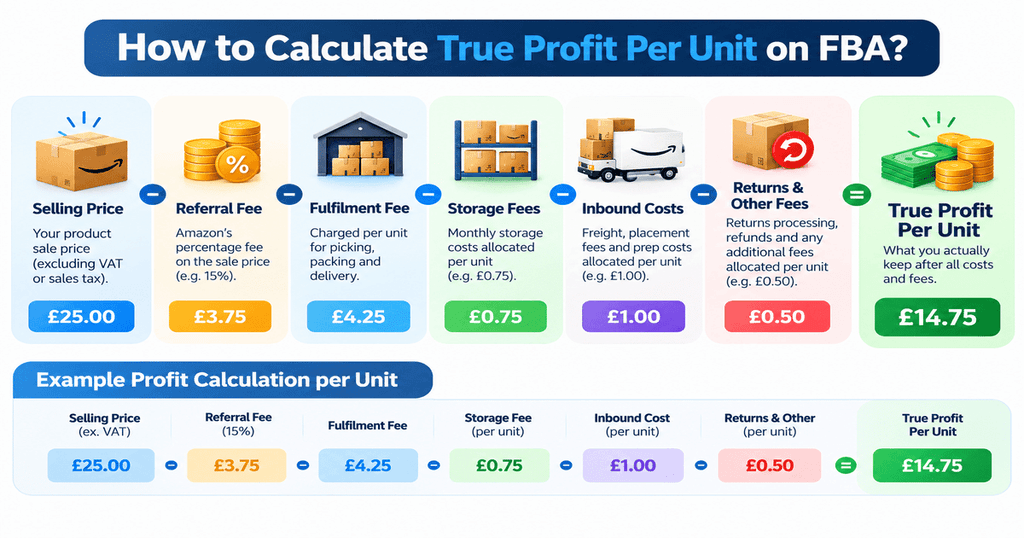
To calculate true FBA profit per unit, start with the selling price excluding VAT or sales tax, then deduct product cost, inbound costs, referral fee, fulfilment fee, storage per unit, a returns allowance and advertising per unit. What remains is your contribution per unit. Many sellers find a product they thought was highly profitable barely breaks even.
Worked example: two products compared
The figures below are illustrative, for a UK seller, excluding VAT. Product A is small and light. Product B is bulky and slower-selling.
| Per unit (£) | Product A | Product B |
|---|---|---|
| Selling price (ex VAT) | 25.00 | 30.00 |
| Product cost | -7.50 | -9.00 |
| Inbound freight and placement | -0.90 | -2.10 |
| Referral fee | -4.50 | -5.40 |
| FBA fulfilment fee | -3.40 | -7.80 |
| Storage (allocated per unit) | -0.45 | -1.90 |
| Returns allowance | -0.60 | -0.75 |
| Advertising (per unit sold) | -3.00 | -3.20 |
| Profit per unit | 4.65 | -0.15 |
| Margin on selling price | 18.6% | -0.5% |
Looked at simply as price minus product cost, Product A appears to make £17.50 a unit and Product B £21.00. On that view, Product B looks like the better product. Once FBA fees, storage and advertising are included, the picture reverses. Product A makes a healthy profit, while Product B loses money on every unit sold.
How to allocate storage per unit
Storage fees are charged on your whole inventory, not per sale. A practical method is to take each product’s monthly storage charge, from Amazon’s storage fee reports, and divide it by units sold in the month. Slow sellers carry a higher storage cost per unit, which is exactly the point.
What the numbers tell you
Profit-per-unit analysis supports decisions such as:
- Raising prices or reducing advertising on thin-margin products
- Changing packaging to move into a cheaper size tier
- Fulfilling bulky items yourself or through a third-party warehouse
- Removing or liquidating slow, storage-heavy stock
- Focusing reorders and advertising on the products that genuinely make money
None of these decisions is possible if your books show only a single Amazon payout recorded as sales.
What are the most common FBA bookkeeping mistakes?
The most common FBA bookkeeping mistakes are lumping all Amazon fees into one line, netting fees off sales, treating stock at Amazon as already sold, ignoring reimbursements and lost units, expensing inbound costs inconsistently, and never reconciling FBA inventory. Together, they make margins look better or worse than they really are.
- One line for all Amazon fees. You cannot manage what you cannot see. Split fees by type.
- Expensing stock when it ships to Amazon. Sending stock to FBA is a transfer between locations, not a sale or a cost. It stays in inventory until a customer buys it.
- Ignoring reimbursements. Unrecorded reimbursements understate income, and unrecorded losses overstate inventory.
- Inconsistent treatment of inbound costs. Capitalising freight one month and expensing it the next makes margins jump around for no real reason.
- No inventory reconciliation. Books that disagree with Amazon’s inventory reports eventually need a large, painful adjustment.
- Forgetting peak-season storage. Higher storage rates at the end of the year can surprise sellers who budgeted on earlier months.
When should you get help with FBA accounting?
Get help if you cannot say what FBA costs you per unit, if your inventory figures do not match Amazon’s reports, if you have never recorded a reimbursement, or if your accountant is struggling to finalise your year end. These are signs that FBA activity is not being captured properly, and the gap tends to grow each month.
Frequently asked questions
Are FBA fees cost of sales or overheads?
Fulfilment and referral fees vary directly with sales, so many sellers include them in cost of sales to show a true gross margin. Storage fees are often shown as an operating cost. Choose a structure with your accountant and apply it consistently.
Is stock held at Amazon FBA still my inventory?
Yes. Until a customer buys it, stock in Amazon’s warehouses belongs to you and should be included in your inventory on the balance sheet, at cost.
How do I record an FBA reimbursement?
Record the reimbursement as other income or a recovery of inventory losses, and write off the lost or damaged units from inventory at cost. Both sides are needed for accurate books.
Can inbound shipping to Amazon be included in inventory cost?
Often, yes. Costs of bringing stock to its saleable location can form part of inventory cost under common accounting frameworks. Many small sellers expense them instead for simplicity. Agree a consistent policy with your accountant.
How do I work out FBA profit per product?
Deduct product cost, inbound costs, referral and fulfilment fees, allocated storage, returns and advertising from the selling price excluding tax. What remains is your profit per unit.
How often should I reconcile FBA inventory?
Monthly is ideal, and at least quarterly. Compare the units in your books with Amazon’s inventory reports and investigate any differences.
The bottom line
FBA can be a brilliant way to scale, but only if you can see what it really costs. Recording each fee by type, treating FBA stock as your inventory, capturing reimbursements and reconciling units to Amazon’s reports turns FBA from a black box into a set of numbers you can manage. Profit per unit then tells you which products deserve more investment, and which are quietly losing money.
If your Amazon fees are a single line in your accounts, or your FBA inventory has never been reconciled, Rescue My Books can help you rebuild your Amazon records and understand your true margins.